Contract review that checks what is missing
A contract of any length is compared with your own standard documents. You get a list of missing clauses, contradictions and improvements, each with suggested wording, to work through in minutes.
Problem
Reviewing a contract takes senior time. A careful reviewer reads it line by line and compares it with the company’s standard positions, from memory or from a document open beside it. People are inconsistent: two reviewers, or one reviewer on a Monday and on a Friday, find different things.
The costly mistake is the clause that is not there. A missing liability cap, data-protection clause or termination right is far harder to notice than a bad clause that is present. And the long contracts, master agreements with annexes, service levels and schedules running to hundreds of pages, are exactly where tiredness and skipped sections do the most damage.
Approach
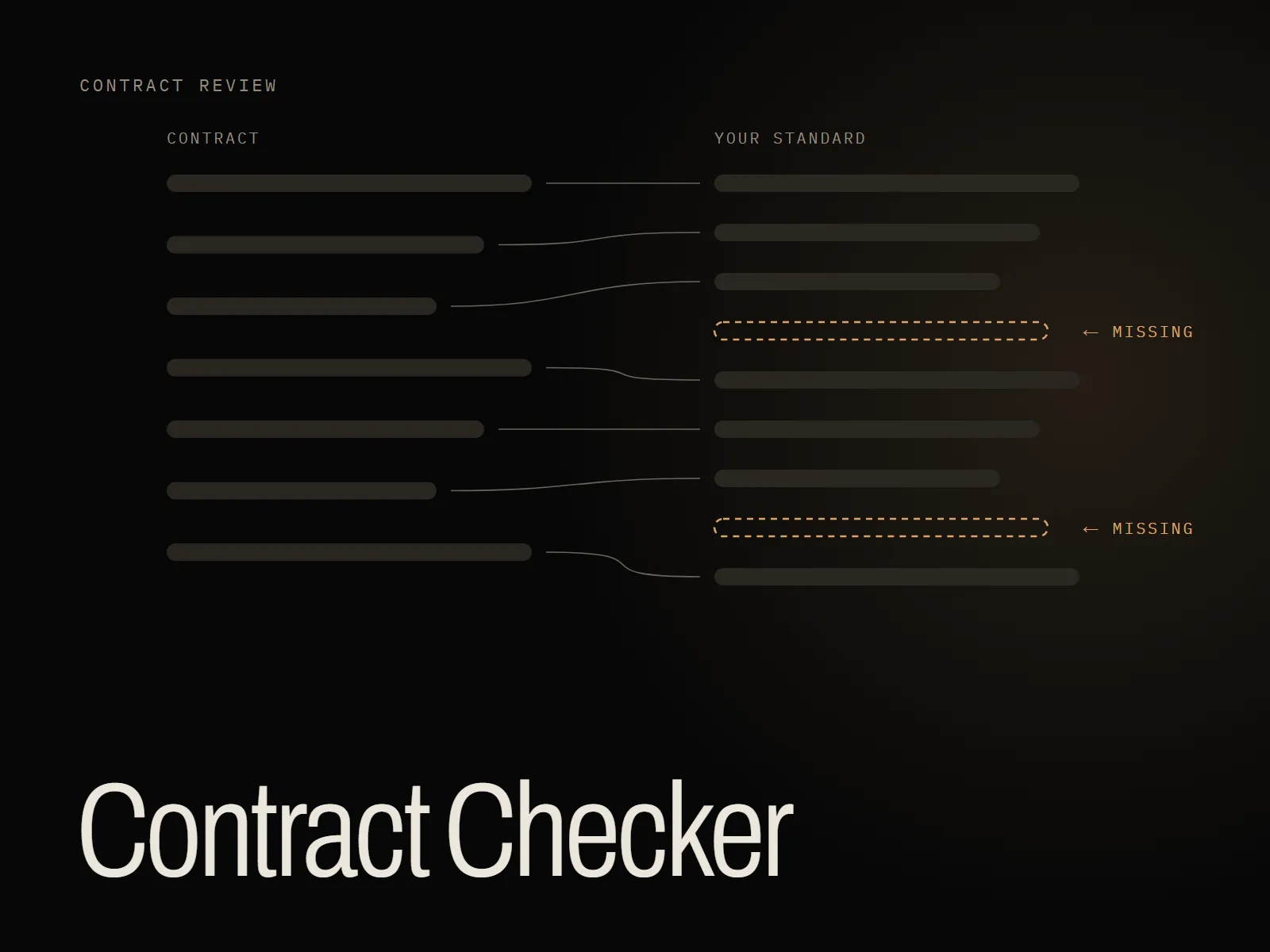
Contract Checker compares a contract with the organisation’s own templates and standard documents, in both directions:
- Forward pass, contract to standard
How does each thing the contract says compare with our standard?
Finds: Contradictions and improvements
- Reverse pass, standard to contract
Is each thing our standard requires actually in the contract?
Finds: Missing clauses
A reviewer reading only the contract, person or machine, cannot see what is not in it. The reverse pass walks through every requirement in the standard and looks for it in the contract.
Each finding has a severity, a confidence score, the reasoning behind it and suggested replacement wording. The result is an interactive side-by-side report: the reviewer accepts or dismisses each finding, asks for a new suggestion with their own instructions, and exports the result. A lawyer, a procurement officer or an account manager can work through it in minutes, and non-legal teams get a structured first pass instead of escalating everything or nothing.
How it is built
No contract is too long. The tool never needs the whole contract in one prompt. It splits the document into sections, overlapping the pieces so no clause is cut in half, and analyses each section only with the few passages of the standard that match it. Matching is done by meaning (vector search), not by keywords. So the prompts stay small, the cost grows in step with the number of sections, and parallel calls absorb most of the time. Pasting a long PDF into a chat window, by contrast, fails or quietly truncates past the model’s limit.
Contracts stay out of the database. Contracts are processed locally and the reports are written to disk. Only the company’s own templates are indexed in the database. The model keeps nothing between calls. Every call goes through one gateway, the single place to control where data goes, and the model behind it can be swapped without code changes.
Duplicates merged, costs visible. Findings from both passes and from several templates are grouped by meaning, and the most severe one with the fullest suggestion is kept. Token use and cost are counted for every run.
Python, FastAPI and a React dashboard with drag-and-drop upload and live progress, PyMuPDF and python-docx to read PDF and Word files, Postgres with pgvector for the templates. The report is a single self-contained HTML file that loads nothing from the internet.
What it is worth: an illustration
Saving reviewer time is the smaller part of the return. The larger part is risk: a gap in a contract rarely causes trouble, but when it does, it is expensive. A missing liability cap turns a dispute into an uncapped claim. Missing data-protection terms expose you to GDPR fines of up to 4% of annual turnover. A missing exit right locks you into a bad deal for years.
The figures below are an illustration, not measured results: deliberately modest assumptions, to show how the return is built. Put in your own numbers.
Thirty contracts a year, 40 pages on average. A careful review takes about two hours; with the report it still takes one, because a person reads every finding and the key clauses. Legal time costs €100 an hour. One contract in a hundred hides a gap that later costs money, on average €50,000 when it does, and the tool helps catch a third of those. A run costs about €3 in model use, hosting and upkeep €150 a month.
| Per year | |
|---|---|
| Reviewer hours saved | 30 |
| Value of reviewer time saved | €3,000 |
| Expected cost of missed gaps without the tool | €15,000 |
| Expected cost avoided | €5,000 |
| Models, hosting and upkeep | €1,890 |
| Net value | €6,110 |
Even in a year when nothing goes wrong, the time saved covers the running costs. And the risk does not need to happen often: one avoided incident pays for more than 25 years of running the tool.
Expected cost is an average over many contracts, not a promise about any one of them, and the one-time cost of setting the tool up with your templates is not included.
What the table leaves out
Much of the value is not in money:
- Signing with confidence. You know every requirement of your standard was looked for, not just the clauses someone happened to notice.
- The same standard every time. A contract gets the same review on a Friday evening before a deadline as on a quiet Monday morning, whoever reviews it.
- Lawyers on judgement, not on reading. Their time goes to negotiating the findings that matter, not to comparing documents line by line.
- A first pass anyone can do. Sales and procurement can check a contract against the standard themselves and bring legal in only where it is needed, and they learn the company’s positions from the findings as they go.
- A record of what was checked. Every finding, its reasoning and the decision taken on it stay in the report, so you can show later how a contract was reviewed.
- Negotiating from strength. A clear list of gaps with suggested wording makes it easier to ask the other side for changes.
Result
Contract Checker is used on real contract drafts for real customers: about 25 contracts so far, each checked against a base of 10 existing, polished contracts that serve as the standard. Its five users are at management level. It supports the reviewer rather than replacing them; a qualified person still signs off.
Have a process like this?
The first consultation is free. Then you get an offer that shows what the automation will cost and how much it should save.
Tell me about it Next project Company chatbot that answers from your own documents1,100 h saved per year